

High Voltage Epoxy Bushing: A Complete Guide to Design, Standards, and Selection
The following is the table of contents for this article.
Thanks for sharing the article.
Electrical networks depend on components that rarely get noticed until something goes wrong — and the high voltage epoxy bushing is one of them. Tucked inside transformers, switchgear, and GIS equipment, this insulating component allows a live conductor to pass safely through a grounded enclosure. Get the selection wrong, and the consequences range from partial discharge and premature aging to catastrophic flashover. Get it right, and it quietly does its job for decades.
This guide breaks down what a high voltage epoxy bushing is, how it’s built, why utilities and EPC contractors increasingly choose epoxy over porcelain or oil-filled designs, and what to check before ordering.
What Is a High Voltage Epoxy Bushing?
A high voltage epoxy bushing is an insulated through-connection that allows a conductor to pass through a grounded barrier — a transformer tank wall, a switchgear panel, or a wall between substation compartments — while maintaining electrical isolation between the live conductor and the earthed structure.
Unlike traditional porcelain bushings, which rely on a ceramic shell (and sometimes oil impregnation) for insulation, an epoxy bushing uses cast or molded epoxy resin, typically reinforced with fillers such as quartz sand or silica, to provide the dielectric barrier. The conductor — usually copper or aluminum — runs through the center of the epoxy body, which is shaped with sheds (ribs) to increase creepage distance and resist surface tracking.
Epoxy bushings are used across a wide range of equipment, including:
- Ring main units (RMUs) and load-break switches
- Vacuum circuit breakers and switchgear panels
- Dry-type and oil-filled distribution transformers
- Gas-insulated switchgear (GIS) wall and partition penetrations
How High Voltage Epoxy Bushings Are Made
Most modern epoxy bushings are produced using Automatic Pressure Gelation (APG), a molding process where a resin-hardener-filler mixture is injected into a heated mold under pressure and cured around the conductor. APG production is preferred industry-wide because it minimizes voids and air pockets in the resin — the leading cause of internal partial discharge — and produces a dense, uniform insulation body.
Key design elements include:
- Conductor: sized for the rated current and temperature rise limits
- Epoxy body: cast with shed profiles calculated for the required creepage distance based on pollution level
- Embedded or applied grading elements: used on some designs to control the electric field at the flange and reduce partial discharge risk
- Flange or mounting interface: matched to the panel, tank wall, or gas compartment it will be installed in
Why Choose Epoxy Over Porcelain or Oil-Filled Bushings
Porcelain bushings have been the industry default for generations, but epoxy designs have steadily replaced them in medium- and high-voltage applications for several reasons:
- Mechanical strength — Epoxy resin resists impact and cracking far better than ceramic, reducing breakage risk during transport, installation, and seismic events.
- No oil, no leaks — Oil-filled bushings introduce a maintenance burden (oil sampling, leak monitoring, disposal) that epoxy designs eliminate entirely.
- Compact footprint — Epoxy bushings can be molded into more compact profiles, which matters for space-constrained substations and indoor switchgear.
- Better performance in polluted or humid environments — Properly profiled epoxy sheds shed contamination and moisture more effectively than smooth porcelain in many field conditions.
- Consistent quality control — APG molding is a repeatable industrial process, which supports tighter dimensional and dielectric consistency across production batches.
That said, epoxy is not universally “better” in every scenario — porcelain and oil-filled bushings still have a place in very high voltage transmission-class applications where decades of field history and specific creepage requirements favor established designs. Specification should always be driven by the actual voltage class, pollution level, and equipment interface.
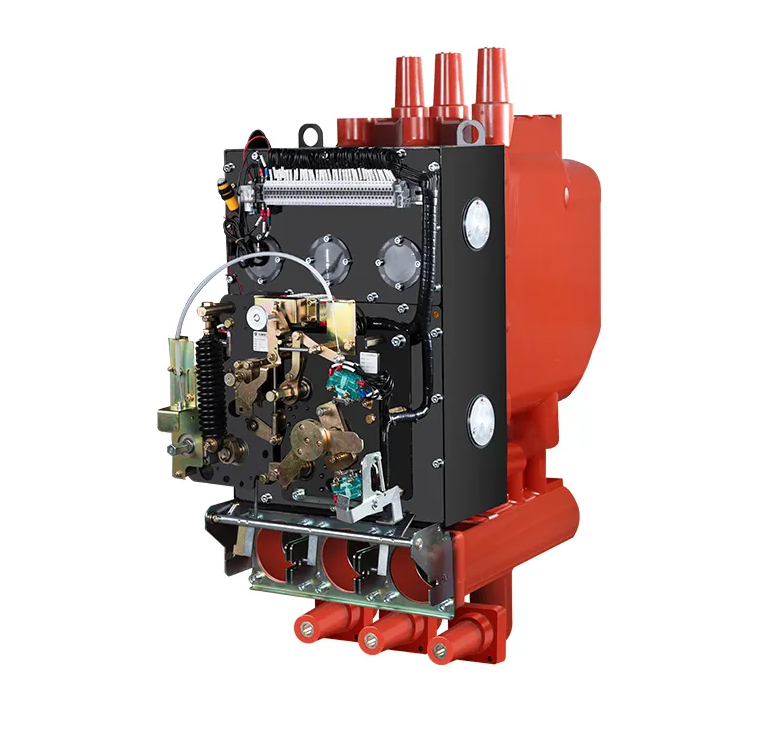
High voltage epoxy bushing with epoxy resin sheds for medium voltage switchgear
Standards and Testing
Any high voltage epoxy bushing supplied for utility or industrial use should be designed and tested in accordance with IEC 60137, which specifies the characteristics and tests for insulated bushings used in electrical apparatus, machinery, transformers, and switchgear operating above 1,000 V. The current edition also formally recognizes resin-impregnated synthetic bushing designs and expanded the voltage classes covered by the standard, so it’s worth confirming which edition a supplier is testing against before placing an order (see the IEC 60137 standard page).
Typical routine and type tests for epoxy bushings include:
- Power-frequency withstand voltage
- Lightning impulse (BIL) withstand
- Partial discharge measurement (commonly required below 5–10 pC at 1.1× rated voltage)
- Temperature rise testing
- Cantilever/mechanical load testing for bushings subject to busbar stress
Buyers should always request test reports for the specific batch or type being purchased, not just a generic catalog compliance statement. For background on how bushing standards have evolved, In Compliance Magazine has a useful summary of the most recent IEC 60137 revision and what changed.
How to Select the Right Epoxy Bushing for Your Project
When specifying a high voltage epoxy bushing, work through these points with your supplier:
- Rated voltage (Um) and BIL — match to the system’s insulation coordination requirements, not just the nominal operating voltage.
- Rated current and temperature rise — undersized conductors overheat under sustained load; oversized ones add unnecessary cost and weight.
- Creepage distance — driven by the site’s pollution severity class (light, medium, heavy, very heavy), especially for coastal, industrial, or desert environments.
- Mounting interface — flange dimensions and bolt patterns must match the panel, tank, or GIS compartment exactly.
- Application environment — indoor vs. outdoor, oil-to-air, air-to-air, or gas-to-air configurations all require different bushing designs.
- Certification — confirm IEC 60137 compliance (or the relevant national standard, such as GB/T 4109) with test reports available on request.
Where High Voltage Epoxy Bushings Fit in Degatech’s Product Line
At Degatech, epoxy bushings are engineered as part of a broader medium-voltage equipment portfolio rather than as a standalone commodity part. They’re manufactured to complement our switchgear products, including solid insulated and gas-insulated panels, and our transformer range, where reliable bushing performance is just as critical as the core equipment itself. Because bushing failures are often traced back to the internal interrupting or insulation components around them, it’s worth reviewing how they interact with parts like our vacuum interrupters when specifying a complete switchgear or transformer package.
Since being established in 2007, our team has focused on 35kV-and-below power equipment for global utility, industrial, and EPC customers, with production based in Zhejiang and logistics support through nearby Ningbo and Shanghai ports. You can read more about the company’s background on our company profile page.
Frequently Asked Questions
What’s the difference between an epoxy bushing and a porcelain bushing? An epoxy bushing uses cast or molded resin for insulation, while a porcelain bushing uses a ceramic shell, sometimes combined with oil. Epoxy designs are generally lighter, more impact-resistant, and require less ongoing maintenance.
What voltage range do epoxy bushings cover? Epoxy bushings are commonly used from 1 kV up through the medium-voltage range (up to around 40.5 kV), with some resin-impregnated designs extending into higher transmission-class voltages under IEC 60137.
How long do epoxy bushings typically last? With correct specification, quality APG molding, and proper installation, epoxy bushings commonly achieve service lives comparable to the rest of the switchgear or transformer they’re installed in — often 25 years or more.
Do epoxy bushings require maintenance? Routine visual inspection for surface tracking, contamination, or cracking is recommended, but epoxy bushings don’t carry the oil sampling or leak-monitoring burden associated with oil-filled designs.
Looking for high voltage epoxy bushings matched to your switchgear or transformer specification? Contact the Degatech team with your voltage class, current rating, and mounting requirements for a tailored quotation.

Wind Substation Equipment: Types, Functions, and Selection Guide
Wind substation equipment plays a critical role in collecting, transforming, protecting, and transmitting electricity generated by wind turbines. From medium-voltage (MV) switchgear and power transformers to high-voltage (HV) equipment, protection [...]

Solar Farm Switchgear: Selection, Design, and Application Guide
Solar farm switchgear is an essential part of the electrical infrastructure used to collect, control, protect, and distribute power generated by photovoltaic (PV) systems. From inverter output circuits and transformer [...]

Future-Proof Switchgear: Design, Selection, and Long-Term Reliability
Future-proof switchgear is designed and selected to accommodate changing electrical loads, evolving technologies, operational requirements, and future expansion with minimal disruption. For industrial facilities, commercial buildings, utilities, renewable energy projects, [...]