

Grid Resilience: Building Stronger and More Reliable Power Networks
The following is the table of contents for this article.
Thanks for sharing the article.
Modern electricity networks face increasingly complex operating conditions.
Extreme weather, equipment failures, changing electricity demand, distributed generation, cyber risks, wildfires, and other disruptions can affect the availability of power.
At the same time, society is becoming more dependent on electricity for transportation, communications, healthcare, data centers, industrial processes, and essential services.
Grid resilience is the ability of an electrical power system to prepare for disruptive events, withstand their effects, respond effectively, and recover service while maintaining safe and reliable operation.
Resilience is broader than simply preventing outages. It also involves limiting the impact of disruptions and restoring service as effectively as possible.
Modern switchgear, automation, digital monitoring, network redundancy, distributed energy resources, and battery storage can all contribute to a grid resilience strategy.
What Is Grid Resilience?
Grid resilience describes how well an electricity system can deal with unexpected disruptions.
A resilient grid should be capable of:
- Preparing for potential threats.
- Withstanding disturbances where possible.
- Detecting problems quickly.
- Isolating affected equipment or network sections.
- Maintaining service to unaffected areas.
- Restoring normal operation after an event.
Grid resilience is closely related to reliability, but the two concepts are not identical.
Reliability often focuses on the frequency and duration of service interruptions under normal operating conditions.
Resilience places greater emphasis on preparing for and recovering from significant disruptions.
Why Grid Resilience Matters
Electricity is increasingly critical to almost every part of modern infrastructure.
A prolonged power interruption can affect:
- Hospitals
- Water systems
- Telecommunications
- Transportation
- Data centers
- Manufacturing
- Commercial buildings
- Residential customers
Electrification can increase this dependency further.
For example, if transportation, heating, and industrial processes increasingly depend on electricity, disruptions to the power system can have wider consequences.
Common Threats to Grid Resilience
Power networks can be affected by many different risks.
Severe Weather
Storms, high winds, flooding, ice, extreme temperatures, and other weather events can damage electrical infrastructure.
Equipment Failure
Transformers, switchgear, cables, protection systems, and other components can fail.
A resilient system needs effective protection and isolation to prevent a local equipment problem from affecting a larger portion of the network.
Wildfires
In areas exposed to wildfire risk, utilities may need additional operational and infrastructure measures.
The appropriate strategy depends on local conditions and regulatory requirements.
Increasing Demand
Rapid load growth can place additional pressure on feeders, transformers, and substations.
Examples include:
- EV charging
- Data centers
- Industrial electrification
- Large commercial developments
Distributed Energy Resources
Solar PV, wind generation, and battery storage can change traditional power-flow patterns.
Protection and control systems may need to account for these changing conditions.
The Role of Medium-Voltage Switchgear
Medium-voltage switchgear is one of the most important equipment categories for improving distribution-grid resilience.
Switchgear can:
- Interrupt faults
- Isolate equipment
- Control feeders
- Protect transformers
- Separate network sections
- Support remote switching
A properly designed switchgear system can help prevent a fault on one part of a network from unnecessarily affecting other sections.
Vacuum Circuit Breakers
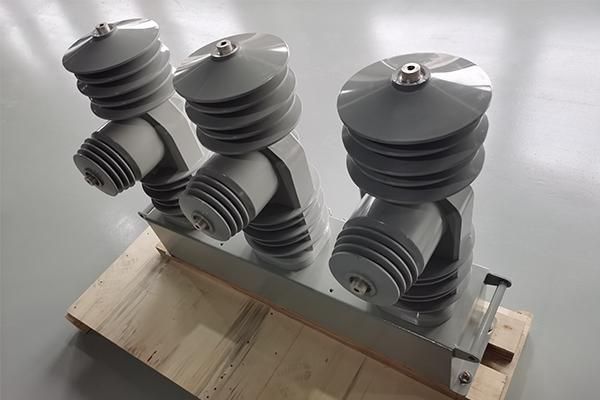
Vacuum circuit breakers are widely used in MV distribution applications.
A VCB can be integrated with digital protection and automation systems to provide fast fault interruption and controlled switching.
Important selection parameters include:
- Rated voltage
- Rated current
- Short-circuit breaking capacity
- Short-time withstand current
- Insulation level
- Mechanical endurance
The actual requirements depend on the network.
Smart Switchgear and Digital Monitoring
Traditional switchgear can provide local switching and protection.
Modern smart switchgear can add digital capabilities.
Depending on configuration, these can include:
- Current measurement
- Voltage measurement
- Breaker status
- Fault indication
- Temperature monitoring
- Event recording
- Remote control
- Communication
This information can improve the utility’s visibility into the distribution network.
Why Visibility Supports Resilience
When an outage occurs, operators need to understand:
- Where the fault occurred
- Which equipment operated
- Which feeders remain energized
- Which switching devices are available
- Which customers may be affected
Digital monitoring can provide this information more quickly than relying solely on manual inspection.
Distribution Automation
Distribution automation can further strengthen grid resilience.
An automated feeder may use:
- Motorized switchgear
- Automated RMUs
- Fault passage indicators
- RTUs
- Digital relays
- SCADA
- Communication networks
Fault Isolation and Restoration
Consider a distribution feeder with several sections.
If a fault occurs in one section, the protection system can interrupt the fault.
With suitable automation and network configuration, the system may then:
- Detect the fault.
- Open the relevant circuit breaker.
- Identify the affected section.
- Operate switching devices.
- Isolate the faulted section.
- Restore supply to unaffected sections where technically possible.
The actual operation depends on the network design and protection philosophy.
Redundancy and Network Reconfiguration
Resilient grids often use network configurations that provide alternative supply paths where practical.
For example, a distribution network may be designed so that a feeder can be supplied from another direction after a fault.
This is sometimes described as network reconfiguration or alternative-feed capability.
However, additional redundancy increases infrastructure requirements.
Utilities therefore need to balance:
- Reliability objectives
- Capital cost
- Network complexity
- Available capacity
- Operational requirements
Renewable Energy and Grid Resilience
Distributed renewable energy can change how resilience is achieved.
Traditional distribution networks generally rely on centralized generation and one-way power flows.
Distributed generation creates additional sources of electrical power.
For example:
Solar PV + Battery → Local loads
may provide an alternative source during certain grid conditions if the system is appropriately designed and permitted to operate in that mode.
However, renewable generation does not automatically make a grid resilient.
Engineers need to consider:
- Protection
- Islanding
- Inverter controls
- Storage capacity
- Grid-forming or grid-following behavior
- Network configuration
The technical capabilities of the complete system determine the resilience benefits.
Battery Energy Storage and Grid Resilience
Battery energy storage can provide flexibility during certain grid disturbances.
A typical system may include:
Battery → PCS → Transformer → MV Switchgear → Grid
Potential applications include:
- Backup support
- Peak management
- Renewable integration
- Microgrid operation
- Voltage support
The actual resilience value depends on system configuration, battery capacity, controls, interconnection requirements, and operating strategy.
Why Storage Matters
Unlike solar or wind generation, battery systems can be controlled to charge and discharge according to system requirements.
This makes storage potentially useful for maintaining supply to selected loads during certain disruptions.
 Microgrids and Resilient Power Systems
Microgrids can provide another approach to resilience.
A microgrid can combine:
- Local generation
- Battery storage
- Switchgear
- Protection
- Controls
- Local loads
Depending on the design, a microgrid may operate:
- Connected to the utility grid
- In an intentional islanded mode
Critical facilities such as hospitals, campuses, industrial sites, and emergency facilities may consider microgrid architectures where appropriate.
The ability to operate independently depends on the system’s generation, storage, protection, controls, and regulatory requirements.
SF6-Free Switchgear and Grid Modernization
Environmental performance and resilience do not have to be separate objectives.
When aging switchgear is replaced, utilities can evaluate modern technologies that provide both operational and environmental benefits.
For suitable medium-voltage applications, this may include:
- Vacuum circuit breakers
- Air-insulated switchgear
- Solid-insulated switchgear
- SF6-free designs
Modernization can also introduce:
- Digital protection
- Remote monitoring
- Motorized switching
- Communication
This means one replacement project can address aging infrastructure, operational visibility, automation, and environmental objectives.
How to Build a Grid Resilience Strategy
A practical resilience program should start with a network assessment.
1. Identify Critical Loads
Determine which customers and facilities require the highest level of continuity.
These may include:
- Hospitals
- Emergency services
- Water infrastructure
- Data centers
- Critical industrial facilities
2. Identify Vulnerable Assets
Assess:
- Aging switchgear
- Transformers
- Overloaded feeders
- Exposed overhead lines
- Communication systems
- Protection equipment
3. Evaluate Network Configuration
Determine whether alternative supply paths exist.
Assess whether critical feeders can be supplied from multiple sources where appropriate.
4. Upgrade Protection
Review:
- Relay settings
- Coordination
- Fault levels
- Breaker ratings
- Protection communication
5. Add Automation
Consider:
- Remote switching
- Automated fault isolation
- SCADA
- Smart RMUs
- Digital monitoring
6. Evaluate Distributed Resources
Consider whether:
- Solar
- Battery storage
- Microgrids
- Backup generation
can support resilience objectives.
7. Establish a Recovery Plan
Resilience also depends on operational readiness.
Utilities should consider:
- Spare equipment
- Emergency response
- Maintenance procedures
- Restoration plans
- Communication systems
 How to Select Equipment for Grid Resilience
Equipment selection should begin with the network’s technical requirements.
Switchgear
Evaluate:
- Voltage
- Current
- Short-circuit rating
- Insulation
- Mechanical endurance
- Operating mechanism
Protection
Evaluate:
- Overcurrent protection
- Earth-fault protection
- Directional protection where required
- Communication
- Event recording
Automation
Consider:
- Remote operation
- Motorized mechanisms
- RTUs
- SCADA
- Communication protocols
Environmental Conditions
Consider:
- Temperature
- Humidity
- Altitude
- Pollution
- Flood risk
- Outdoor exposure
Lifecycle Support
Review:
- Spare parts
- Maintenance
- Service support
- Testing
- Documentation
- Expected service life
Frequently Asked Questions
What is grid resilience?
Grid resilience is the ability of an electrical power system to prepare for, withstand, respond to, and recover from disruptive events while maintaining safe and reliable operation.
What is the difference between grid resilience and reliability?
Reliability generally focuses on consistent electricity service during normal operating conditions. Resilience focuses more on preparing for, limiting, responding to, and recovering from significant disruptions.
How does switchgear improve grid resilience?
Switchgear can interrupt faults, isolate damaged equipment, control feeders, and separate network sections, helping limit the impact of electrical failures.
Does smart switchgear improve grid resilience?
Smart switchgear can improve operational visibility and control through monitoring, communication, remote operation, fault indication, and automation capabilities.
Can battery storage improve grid resilience?
Battery storage can support resilience in appropriately designed systems by providing controllable electrical power during certain grid conditions or supporting microgrid operation.
Can solar power improve grid resilience?
Solar generation can contribute to resilience when properly integrated with appropriate controls, protection, storage, and islanding capabilities. Solar alone does not automatically provide backup power during a grid outage.
What is a resilient distribution grid?
A resilient distribution grid is designed to limit the impact of faults and disruptive events and to restore service effectively. It may use automated switching, alternative supply paths, distributed resources, and modern protection.
How does distribution automation support resilience?
Distribution automation can detect faults, provide network information, and operate switching devices remotely or automatically, potentially reducing the area and duration of an outage.
Can microgrids improve grid resilience?
Yes. A properly designed microgrid can provide local generation and storage and may be capable of operating independently from the utility grid under suitable conditions.
What equipment should utilities prioritize for resilience upgrades?
Priorities depend on the network, but common areas include aging switchgear, protection systems, transformers, automated switching, communications, and infrastructure serving critical loads.
Conclusion
Grid resilience requires more than stronger physical infrastructure. It requires a coordinated combination of protection, automation, monitoring, network design, distributed energy resources, and operational planning.
Modern medium-voltage switchgear is an important part of this strategy.
Utilities can improve resilience through:
- Modern MV switchgear
- Vacuum circuit breakers
- Smart monitoring
- Distribution automation
- Network reconfiguration
- Battery energy storage
- Microgrids
- Renewable energy integration
- Digital protection
The right solution depends on the threats facing a particular network and the critical loads it serves.
For utilities and EPC contractors, the most effective approach is to identify vulnerable assets, understand network dependencies, prioritize critical infrastructure, and deploy technologies that improve both fault management and recovery.
A resilient grid is not necessarily a grid that never experiences disruptions. It is a grid designed to limit their consequences and recover effectively when disruptions occur.

Wind Substation Equipment: Types, Functions, and Selection Guide
Wind substation equipment plays a critical role in collecting, transforming, protecting, and transmitting electricity generated by wind turbines. From medium-voltage (MV) switchgear and power transformers to high-voltage (HV) equipment, protection [...]

Solar Farm Switchgear: Selection, Design, and Application Guide
Solar farm switchgear is an essential part of the electrical infrastructure used to collect, control, protect, and distribute power generated by photovoltaic (PV) systems. From inverter output circuits and transformer [...]

Future-Proof Switchgear: Design, Selection, and Long-Term Reliability
Future-proof switchgear is designed and selected to accommodate changing electrical loads, evolving technologies, operational requirements, and future expansion with minimal disruption. For industrial facilities, commercial buildings, utilities, renewable energy projects, [...]