
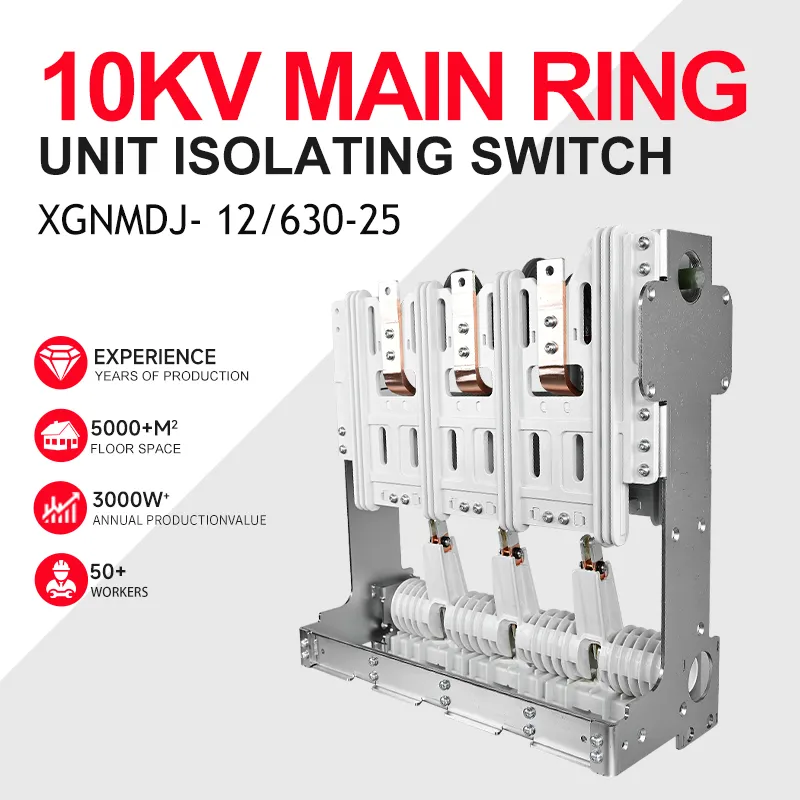
Eco-Friendly VCB Retrofit Solutions for Aging Medium Voltage Switchgear
The following is the table of contents for this article.
Thanks for sharing the article.
Introduction
Across utilities and industrial facilities worldwide, a large portion of medium voltage switchgear has been in service for decades. While many of these installations remain mechanically sound, they often rely on outdated insulation technologies, obsolete components, or environmentally harmful gases such as SF₆. Full switchgear replacement is costly, disruptive, and time-consuming.
Eco-friendly VCB retrofit solutions for aging medium voltage switchgear offer a practical alternative. By upgrading existing panels with modern vacuum circuit breakers and sustainable insulation concepts, operators can extend asset life, improve safety, and meet current environmental regulations—without replacing the entire switchboard.
Challenges of Aging Medium Voltage Switchgear
Older medium voltage switchgear typically faces several challenges:
Degradation of insulation materials
Increased risk of internal arcing
Limited availability of spare parts
Use of SF₆ or oil-based insulation
Non-compliance with modern safety and environmental standards
These issues increase operational risk and maintenance costs while reducing system reliability.
What Is a VCB Retrofit Solution?
A VCB retrofit involves replacing the existing circuit breaker—such as oil or SF₆ breakers—with a modern vacuum circuit breaker, while retaining the original switchgear enclosure, busbars, and cable connections where possible.
Eco-friendly retrofit solutions further enhance this approach by:
Eliminating SF₆ gas
Using dry air or solid insulation
Improving energy efficiency and safety
Why Vacuum Circuit Breakers Are Ideal for Retrofits
Vacuum circuit breakers are particularly well suited for retrofit projects.
Key advantages include:
Excellent arc interruption in vacuum
Long mechanical and electrical life
Minimal maintenance requirements
Compact design suitable for existing compartments
No greenhouse gas emissions
These features make VCBs a natural replacement for legacy breakers.
Eco-Friendly Insulation Technologies in Retrofit VCBs
Modern eco-friendly retrofit solutions typically combine vacuum interruption with sustainable insulation methods.
Common approaches include:
Dry air insulation for external dielectric requirements
Solid insulation systems using epoxy or polymer materials
Hybrid designs combining vacuum and air insulation
These technologies eliminate SF₆ while maintaining required insulation levels.
Design Adaptation for Existing Switchgear
One of the biggest challenges in retrofit projects is compatibility with existing switchgear designs.
Eco-friendly VCB retrofit solutions address this by:
Matching original breaker dimensions and connection points
Adapting racking mechanisms and shutters
Ensuring proper phase spacing and insulation clearance
Integrating with existing protection and control systems
This minimizes downtime and avoids costly panel modifications.
Performance and Reliability Improvements
Retrofitting with eco-friendly VCBs significantly improves system performance.
Benefits include:
Higher interrupting capacity
Reduced risk of internal arcing
Stable dielectric behavior over time
Improved switching reliability under fault conditions
These improvements enhance network stability and operational safety.
Environmental and Regulatory Benefits
Environmental regulations increasingly restrict the use of SF₆ due to its extremely high global warming potential.
Eco-friendly VCB retrofits offer:
Zero greenhouse gas emissions
Compliance with current and future regulations
Simplified handling and end-of-life disposal
Alignment with corporate sustainability goals
For utilities, this also improves ESG reporting and public perception.
Cost and Downtime Advantages
Compared to full switchgear replacement, retrofit solutions provide:
Lower capital expenditure
Shorter installation and commissioning time
Reduced outage duration
Extended service life of existing assets
This makes retrofitting especially attractive for substations and industrial plants with limited shutdown windows.
Typical Applications
Eco-friendly VCB retrofit solutions are widely applied in:
Utility distribution substations
Industrial power plants
Commercial buildings and data centers
Transportation and infrastructure facilities
Any installation with aging MV switchgear can benefit from retrofit modernization.
Standards and Safety Considerations
Retrofit VCBs are designed to meet current international standards for medium voltage equipment.
Key considerations include:
Short-circuit withstand capability
Dielectric and impulse voltage performance
Mechanical endurance
Internal arc classification compatibility
Compliance ensures safe integration into existing systems.
Implementation Strategy for Retrofit Projects
A successful retrofit project typically involves:
Detailed site assessment and switchgear audit
Electrical and mechanical compatibility study
Customized VCB design
Factory testing and site commissioning
Proper planning minimizes risks and ensures smooth execution.
Frequently Asked Questions
Can eco-friendly VCB retrofits replace SF₆ breakers directly?
Yes, in most medium voltage applications, vacuum breakers are a direct and proven replacement.
Will retrofit solutions affect protection settings?
Protection systems may require verification or minor adjustment but usually remain compatible.
Are retrofit VCBs as reliable as new switchgear?
Yes, they often provide superior reliability due to modern design and materials.
Conclusion
Eco-friendly VCB retrofit solutions for aging medium voltage switchgear provide a smart, sustainable, and cost-effective path to modernization. By combining vacuum interruption with SF₆-free insulation technologies, these solutions improve safety, reliability, and environmental performance—while preserving existing infrastructure.
For utilities and industrial operators seeking to future-proof their networks, eco-friendly VCB retrofits represent a practical and responsible investment.

Wind Substation Equipment: Types, Functions, and Selection Guide
Wind substation equipment plays a critical role in collecting, transforming, protecting, and transmitting electricity generated by wind turbines. From medium-voltage (MV) switchgear and power transformers to high-voltage (HV) equipment, protection [...]

Solar Farm Switchgear: Selection, Design, and Application Guide
Solar farm switchgear is an essential part of the electrical infrastructure used to collect, control, protect, and distribute power generated by photovoltaic (PV) systems. From inverter output circuits and transformer [...]

Future-Proof Switchgear: Design, Selection, and Long-Term Reliability
Future-proof switchgear is designed and selected to accommodate changing electrical loads, evolving technologies, operational requirements, and future expansion with minimal disruption. For industrial facilities, commercial buildings, utilities, renewable energy projects, [...]