

Vacuum Circuit Breaker safety guide
The following is the table of contents for this article.
Thanks for sharing the article.
Outline
| Section | Description |
|---|---|
| Introduction | Overview of VCB importance |
| Vacuum Circuit Breaker | Core definition |
| Working Principle | How vacuum interruption works |
| Components of a VCB | Key internal parts |
| Types of VCBs | Classification |
| Advantages | Main benefits |
| Disadvantages | System limitations |
| Applications | Where VCBs are used |
| Operation Mechanism | How operation works |
| Comparison with ACB | Arc vs. Vacuum |
| Comparison with OCB | Oil vs. Vacuum |
| Comparison with SF₆ CB | Gas vs. Vacuum |
| Maintenance Practices | Key maintenance needs |
| Fault Symptoms | Warning signs |
| Testing & Diagnostics | Evaluation techniques |
| Safety Measures | Operator guidelines |
| Environmental Impact | Eco impact |
| Ratings & Standards | Regulations |
| Selecting a VCB | Engineering choices |
| Installation Guidelines | How to install |
| Innovations | New tech |
| Troubleshooting | Problem solving |
| Cost Analysis | Lifecycle economics |
| Future Trends | Technology direction |
| FAQs | Answers |
| Conclusion | Final insights |
Vacuum Circuit Breaker
Vacuum Circuit Breaker
A Vacuum Circuit Breaker (VCB) is a medium-voltage switching device that interrupts fault currents using vacuum interrupters sealed within a high-integrity chamber. When electrical contacts open during a short circuit or overload condition, the resulting arc extinguishes quickly because vacuum contains almost no particles to sustain ionization. This makes VCBs remarkably reliable, safe, and clean compared to oil, air, or SF₆-gas circuit breakers. Today, they serve as the backbone of modern electrical distribution networks, widely used in industries, utilities, infrastructure, and renewable energy systems.
Working Principle of Vacuum Circuit Breaker
The core principle relies on vacuum arc extinction. During normal operation, contacts remain closed, carrying rated current. When a fault occurs, the breaker receives a trip signal and opens the contacts at high speed. A brief arc forms due to metal vapor, but because vacuum lacks ionizable material, the arc collapses almost instantly. Dielectric strength recovers rapidly, allowing safe interruption of even high short-circuit currents. This fast insulation recovery is why VCBs perform exceptionally well in medium-voltage ranges.
Components of Vacuum Circuit Breakers
A VCB’s reliability comes from its carefully engineered components:
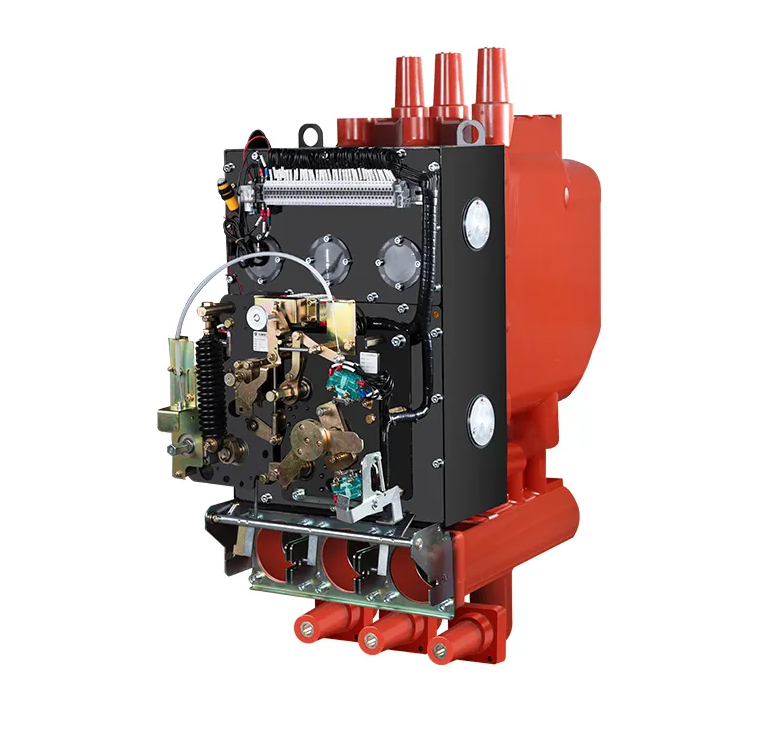
Vacuum Interrupter: The sealed chamber containing fixed and moving contacts.
Arc Shield: Captures metal vapor during arc formation.
Operating Mechanism: Spring-charged or magnetic actuator providing opening/closing force.
Insulating Housing: Ceramic or epoxy structure supporting dielectric strength.
Terminals & Bushing: Provide safe current input/output.
Closing/Trip Coils: Control signals from relays.
Auxiliary Contacts: Support interlocking and monitoring.
Each part is designed to withstand thousands of operations with minimal wear.
Types of Vacuum Circuit Breakers
VCBs can be classified by:
Construction: Fixed type, draw-out type, panel-mounted, or embedded-pole type.
Mechanism: Spring-charged, magnetic actuator, solenoid-based.
Application: Indoor switchgear, outdoor substations, railway traction systems, renewable energy farms.
Pole Structure: Live tank or dead tank configurations.
This classification ensures suitability across diverse environments and electrical conditions.
Advantages of Vacuum Circuit Breakers
VCBs offer numerous strengths:
Long life span due to slow contact erosion.
Exceptional reliability under medium-voltage switching.
Minimal maintenance, no oil or gas refilling.
High dielectric recovery, enabling fast fault interruption.
Compact dimensions ideal for modern switchgear.
Environmentally friendly, containing no SF₆ or oils.
High mechanical endurance supporting frequent operations.
Fire safety advantage since no combustible medium is used.
These benefits make VCBs a preferred choice for new installations.
Disadvantages of Vacuum Circuit Breakers
Despite advantages, VCBs have limitations:
Higher initial cost compared to simple breakers.
Voltage limitation mainly to medium-voltage range.
Requires precise manufacturing of vacuum interrupters.
Not ideal in extremely high-altitude areas without insulation enhancements.
However, these disadvantages are small relative to their performance and reliability.
Applications of Vacuum Circuit Breakers
VCBs are used extensively in:
Industrial facilities such as steel plants and refineries.
Commercial buildings requiring dependable protection.
Utility substations at 11 kV, 22 kV, and 33 kV levels.
Renewable energy systems including wind and solar farms.
Railway traction and metro systems.
Mining operations needing rugged equipment.
Their durability and low maintenance make them ideal for mission-critical operations.
Vacuum Circuit Breaker Operation Mechanism
VCBs employ either spring-charged mechanisms or magnetic actuators:
Spring-charged mechanisms store mechanical energy, releasing it instantly to open or close contacts.
Magnetic actuators offer smoother motion, fewer moving parts, and lower maintenance.
Interlocks, coils, and auxiliary circuits ensure safe operation and precise tripping.
Comparison: Vacuum Circuit Breaker vs. Air Circuit Breaker
| Feature | VCB | ACB |
|---|---|---|
| Arc Medium | Vacuum | Air |
| Maintenance | Very low | Moderate/high |
| Arc Extinction | Fast | Slow |
| Size | Compact | Larger |
| Application | Medium voltage | Low/medium voltage |
VCBs outperform ACBs in arc handling and durability but operate mainly in mid-voltage systems.
Comparison: VCB vs. Oil Circuit Breaker
| Feature | VCB | OCB |
|---|---|---|
| Medium | Vacuum | Mineral Oil |
| Environmental Impact | Zero emissions | Oil disposal required |
| Fire Hazard | None | High |
| Maintenance | Minimal | Frequent |
| Reliability | Very high | Moderate |
VCBs have largely replaced OCBs due to safety and environmental concerns.
Comparison: VCB vs. SF₆ Circuit Breaker
| Feature | VCB | SF₆ CB |
|---|---|---|
| Medium | Vacuum | SF₆ gas |
| Environmental Impact | Very low | High GWP gas |
| Maintenance | Very low | Gas monitoring required |
| Arc Quenching | Excellent | Excellent |
| Cost | Moderate | Moderate/high |
Although SF₆ breakers perform well, the global shift away from greenhouse gases favors VCB deployment.
Maintenance Practices for VCBs
Maintenance is simple but essential:
Visual inspection of housing and terminals.
Checking contact erosion indicators.
Lubricating mechanisms sparingly as per manufacturer guidelines.
Testing insulation resistance and control circuits.
Cleaning dust and moisture from switchgear panels.
Monitoring operation logs to detect unusual trends.
Because interrupters are sealed for life, maintenance focuses mostly on mechanical parts and connections.
Symptoms of Faulty Vacuum Circuit Breakers
Common symptoms include:
Delayed opening or closing due to mechanism wear.
Overheating terminals indicating loose connections.
Unusual noises from internal friction.
Failure to trip from faulty coils or relays.
Vacuum loss, detectable through specialized testing.
Increased contact resistance, signaling deterioration.
Early detection prevents system failures and costly downtime.
Testing & Diagnostic Techniques
Diagnostic procedures include:
Contact resistance testing for proper conduction.
Insulation resistance measurement using a megohmmeter.
Timing analysis to verify opening/closing speed.
High-potential (HiPot) tests for dielectric strength.
Secondary injection tests to verify relay trip signals.
Vacuum integrity tests for interrupters.
Infrared thermography for hotspot detection.
These tests ensure the VCB remains dependable under real conditions.

Safety Measures
To handle VCBs safely:
Follow lockout/tagout procedures.
Use proper PPE such as arc-rated clothing.
Confirm absence of voltage with calibrated testers.
Avoid touching mechanisms with stored energy.
Ensure proper grounding and environmental dryness.
Verify interlocks before operation.
Safety compliance prevents both electrical and mechanical hazards.
Environmental Impact of VCBs
VCBs are among the cleanest switching technologies because:
They contain no SF₆ gas, eliminating greenhouse emissions.
They require no oil, avoiding spills and waste disposal.
Arc by-products are minimal and non-toxic.
Most components are recyclable at end-of-life.
They reduce energy losses through low contact resistance.
For sustainability-focused utilities, VCBs are a preferred choice.
Ratings and Standards
VCBs conform to international standards such as:
IEC 62271-100 for AC circuit breakers
IEC 62271-200 for switchgear
IEEE C37.04 / C37.09 for ratings and testing
Key ratings include:
Rated voltage
Rated continuous current
Short-circuit breaking capacity
Mechanical endurance
Insulation level
Compliance ensures safe and global interoperability.
Selecting the Right Vacuum Circuit Breaker
Engineers evaluate:
System voltage and load current
Maximum fault level
Environmental and installation conditions
Mechanism type and maintenance philosophy
Smart grid compatibility
Life-cycle cost, not just purchase price
Proper selection ensures optimal performance and long-term reliability.
Installation Guidelines
Key installation steps:
Ensure clean, dry switchgear environment
Verify breaker ratings match system
Align draw-out cradles correctly
Tighten terminals to specified torque
Test control wiring and interlocks
Conduct pre-commissioning electrical tests
Monitor during initial energization
Correct installation prevents early failures.
Emerging Innovations in VCB Technology
Recent advancements include:
Magnetic actuator mechanisms reducing maintenance
High-density ceramic insulation allowing compact design
Improved contact alloys reducing erosion
IoT-enabled monitoring for predictive maintenance
Fast-reclose capabilities for renewable energy grids
Environmentally neutral materials for future recyclability
VCBs continue evolving alongside smart-grid technologies.
Troubleshooting Common Issues
Typical issues and fixes include:
Does not close: Check coils, control voltage, interlocks
Does not trip: Check relays, trip coil, wiring
Overheating terminals: Tighten connections, inspect busbars
Slow operation: Clean/lubricate mechanism
Vacuum loss: Replace interrupter
High resistance: Clean or replace contacts
Systematic troubleshooting restores reliable performance.
Cost Analysis
While initial cost may be higher than simple breakers, VCBs offer:
Very low maintenance expenses
Long service life
Reduced downtime
High energy efficiency
Strong environmental compliance
When considering 20-year lifecycle costs, VCBs are often the most economical option.
Future Trends
Key trends include:
Deep smart-grid integration
Digital twins and cloud analytics
Environmentally driven replacement of SF₆ breakers
Modular, upgradeable components
Fast-switching solutions for renewables
VCBs will remain central to resilient, sustainable electrical systems.
FAQs
What is a Vacuum Circuit Breaker?
A medium-voltage device that interrupts faults using vacuum interrupters.
How long do VCBs last?
Typically 20–30+ years with minimal maintenance.
Do VCBs need gas refilling?
No, they are sealed for life.
Can VCBs be used in renewable systems?
Yes, they are ideal for wind and solar networks.
Are VCBs environmentally friendly?
Yes—no SF₆, no oil, minimal emissions.
What voltage range do VCBs support?
Generally 3.3 kV to 38 kV.
Conclusion
Vacuum Circuit Breakers combine reliability, sustainability, and advanced performance, making them indispensable to modern medium-voltage power networks. Their efficient vacuum arc-extinguishing technology, long lifespan, minimal maintenance, and environmental advantages position them as the preferred choice for industries, utilities, and renewable energy infrastructures. With ongoing innovation and the global push toward cleaner technologies, VCBs are set to remain a cornerstone of safe and intelligent electrical protection for decades to come.

Wind Substation Equipment: Types, Functions, and Selection Guide
Wind substation equipment plays a critical role in collecting, transforming, protecting, and transmitting electricity generated by wind turbines. From medium-voltage (MV) switchgear and power transformers to high-voltage (HV) equipment, protection [...]

Solar Farm Switchgear: Selection, Design, and Application Guide
Solar farm switchgear is an essential part of the electrical infrastructure used to collect, control, protect, and distribute power generated by photovoltaic (PV) systems. From inverter output circuits and transformer [...]

Future-Proof Switchgear: Design, Selection, and Long-Term Reliability
Future-proof switchgear is designed and selected to accommodate changing electrical loads, evolving technologies, operational requirements, and future expansion with minimal disruption. For industrial facilities, commercial buildings, utilities, renewable energy projects, [...]