
SF₆-Free Switchgear Explained – Eco-Friendly Alternatives for MV Power Systems
The following is the table of contents for this article.
Thanks for sharing the article.
Introduction
Sulfur hexafluoride (SF₆) has been widely used in medium-voltage switchgear for decades due to its excellent insulation and arc-quenching properties. However, SF₆ is also a potent greenhouse gas, with a global warming potential far higher than CO₂. As environmental regulations tighten worldwide, the power industry is rapidly shifting toward SF₆-free switchgear solutions.
SF₆-free switchgear represents a major step toward sustainable, future-proof power distribution, without compromising safety or performance.
Why Move Away from SF₆ Gas
SF₆ offers technical advantages, but its environmental impact is severe.
Key concerns include:
Extremely high global warming potential
Long atmospheric lifetime
Strict handling and reporting regulations
Increasing compliance and disposal costs
Many regions now encourage or mandate alternatives, especially for new installations.
What Is SF₆-Free Switchgear
SF₆-free switchgear refers to MV switchgear designs that do not use SF₆ gas for insulation or arc extinction. Instead, they rely on alternative technologies that provide comparable electrical performance with significantly lower environmental impact.
These designs are increasingly used in both indoor and outdoor applications.
Main SF₆-Free Technologies
Vacuum Interruption
Vacuum interrupters are widely used for arc extinction.
Advantages include:
Excellent breaking performance
Long electrical life
Minimal maintenance
No gas handling
Vacuum technology is now standard for most SF₆-free MV breakers.
Solid Insulation
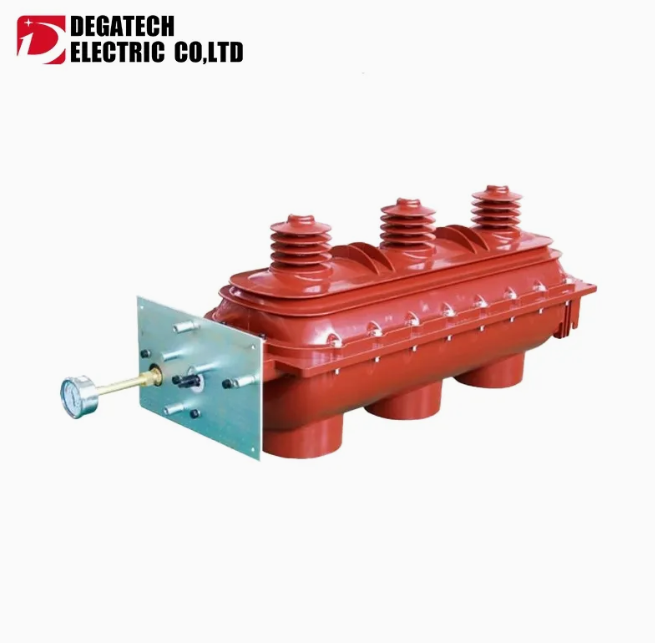
Solid-insulated switchgear uses epoxy resin or polymer materials to provide insulation.
Key features:
Fully sealed insulation system
Compact design
High resistance to pollution and humidity
This approach is common in compact and modular switchgear.
Dry Air Insulation
Dry air is a mixture of natural gases with low environmental impact.
Benefits include:
Zero global warming potential
Simple handling
Familiar operating principles
Dry air is often used in combination with vacuum interrupters.
Alternative Gas Mixtures
Some designs use environmentally friendly gas mixtures with much lower GWP than SF₆.
These solutions offer:
Similar insulation strength
Reduced environmental footprint
Compatibility with compact designs
Typical Applications of SF₆-Free Switchgear
SF₆-free solutions are now used in:
Utility distribution networks
Industrial power systems
Renewable energy plants
Urban substations
Commercial buildings
They are especially attractive in environmentally sensitive or regulated regions.
Performance Comparison with SF₆ Switchgear
| Aspect | SF₆ Switchgear | SF₆-Free Switchgear |
|---|---|---|
| Environmental impact | Very high | Very low |
| Insulation method | SF₆ gas | Vacuum / solid / air |
| Arc extinction | Gas | Vacuum |
| Maintenance | Moderate | Low |
| Regulatory burden | Increasing | Minimal |
| Future compliance | Limited | Strong |
Modern SF₆-free designs meet or exceed standard MV performance requirements.
Safety Considerations
SF₆-free switchgear improves safety by:
Eliminating toxic gas byproducts
Reducing risk during maintenance
Simplifying end-of-life disposal
These benefits are increasingly valued by operators and regulators.
Installation and Operation
From an operational perspective, SF₆-free switchgear:
Uses familiar installation procedures
Requires no gas handling equipment
Simplifies commissioning
Training requirements are often lower than for SF₆ systems.
Maintenance Advantages
Maintenance benefits include:
No gas pressure monitoring
No gas leakage risk
Reduced inspection complexity
This lowers lifecycle cost and improves reliability.
Environmental and Regulatory Benefits
SF₆-free switchgear supports:
Carbon reduction targets
Compliance with environmental regulations
Corporate sustainability goals
Many utilities now specify SF₆-free solutions as a default option.
Challenges and Considerations
Despite advantages, there are considerations:
Initial cost may be slightly higher
Design selection depends on application
Compactness varies by technology
Proper specification ensures optimal performance.
Selection Guidelines
SF₆-free switchgear is recommended when:
Environmental compliance is critical
Long-term sustainability is a priority
Maintenance resources are limited
Urban or indoor installations are required
It is increasingly suitable for both new projects and system upgrades.
Frequently Asked Questions
Is SF₆-free switchgear as reliable as SF₆ types?
Yes. Modern designs meet IEC MV performance standards.
Does SF₆-free switchgear require special training?
Generally less than SF₆ systems due to simpler handling.
Is it suitable for outdoor installations?
Yes, with appropriate enclosure and insulation design.
Will SF₆ be completely banned?
Regulations are tightening, making alternatives increasingly important.
Conclusion
SF₆-free switchgear represents the future of medium-voltage power distribution. By combining vacuum interruption, solid insulation, and environmentally friendly insulating media, it delivers high reliability, lower environmental impact, and reduced lifecycle cost. As regulations evolve and sustainability becomes a priority, SF₆-free switchgear is no longer an alternative—it is the preferred solution for modern power systems.

Wind Substation Equipment: Types, Functions, and Selection Guide
Wind substation equipment plays a critical role in collecting, transforming, protecting, and transmitting electricity generated by wind turbines. From medium-voltage (MV) switchgear and power transformers to high-voltage (HV) equipment, protection [...]

Solar Farm Switchgear: Selection, Design, and Application Guide
Solar farm switchgear is an essential part of the electrical infrastructure used to collect, control, protect, and distribute power generated by photovoltaic (PV) systems. From inverter output circuits and transformer [...]

Future-Proof Switchgear: Design, Selection, and Long-Term Reliability
Future-proof switchgear is designed and selected to accommodate changing electrical loads, evolving technologies, operational requirements, and future expansion with minimal disruption. For industrial facilities, commercial buildings, utilities, renewable energy projects, [...]