
Oil Immersed Transformer: The Backbone of Modern Power Distribution Networks
The following is the table of contents for this article.
Thanks for sharing the article.
Introduction
An oil immersed transformer is one of the most widely used electrical transformers in power generation, transmission, and distribution systems. Designed to provide efficient voltage transformation and reliable electrical insulation, the oil immersed transformer utilizes insulating oil as both a cooling medium and dielectric insulation.
For decades, utilities, industrial facilities, renewable energy projects, and infrastructure developments have relied on oil immersed transformer technology because of its excellent thermal performance, high efficiency, and ability to handle large electrical loads. Despite the growing popularity of dry-type transformers in certain applications, oil-filled transformers remain the preferred choice for outdoor installations and high-capacity power systems.
👉 Explore medium-voltage and power distribution solutions: https://chinadegatech.com/switchgear-products/
What Is an Oil Immersed Transformer?
An oil immersed transformer is a transformer whose core and windings are completely submerged in specially formulated insulating oil. The oil serves two critical functions:
- Electrical insulation
- Heat dissipation
By immersing internal components in insulating oil, the transformer can operate efficiently under high electrical and thermal stresses.
The primary functions of an oil immersed transformer include:
- Voltage step-up and step-down
- Power transmission
- Electrical isolation
- Distribution network support
- Load balancing
These transformers are commonly used across utility substations, industrial plants, and large commercial facilities.
How an Oil Immersed Transformer Works
The operating principle of an oil immersed transformer is based on electromagnetic induction.
Step 1: Primary Winding Energization
Alternating current enters the primary winding and creates a magnetic field within the transformer core.
Step 2: Magnetic Flux Generation
The laminated steel core transfers magnetic flux efficiently between windings.
Step 3: Secondary Voltage Induction
The magnetic field induces voltage in the secondary winding according to the transformer turns ratio.
Step 4: Heat Dissipation
Heat generated by the windings and core is absorbed by the insulating oil and transferred to the cooling system.
This cooling process enables the transformer to operate continuously under heavy electrical loads.
Main Components of an Oil Immersed Transformer
A modern oil immersed transformer consists of several essential components.
Transformer Core
The core is typically constructed from high-quality silicon steel laminations to minimize energy losses.
Windings
Copper or aluminum windings transfer electrical energy through electromagnetic induction.
Transformer Oil
The insulating oil performs both cooling and dielectric insulation functions.
Transformer Tank
A sealed steel tank contains the oil, core, and windings.
Radiators
Radiators increase surface area for efficient heat dissipation.
Bushings
Allow electrical conductors to enter and exit the transformer safely.
Conservator Tank
Accommodates oil expansion and contraction caused by temperature variations.
Protection Devices
Include:
- Buchholz relay
- Pressure relief device
- Oil level indicator
- Temperature monitoring systems
Types of Oil Immersed Transformer
Several types of oil immersed transformer designs are available depending on application requirements.
Distribution Transformer
Used to supply electricity to residential, commercial, and industrial customers.
Typical ratings:
- Up to 5 MVA
- Voltage levels up to 36 kV
Power Transformer
Used in transmission networks and large substations.
Typical ratings:
- Above 5 MVA
- High-voltage applications
Hermetically Sealed Transformer
Completely sealed design prevents moisture ingress and reduces maintenance.
Conservator-Type Transformer
Uses a conservator tank to manage oil expansion during operation.
Advantages of Oil Immersed Transformer Technology
Excellent Cooling Performance
One of the greatest advantages of an oil immersed transformer is superior heat dissipation.
Benefits include:
- Higher load capacity
- Stable operating temperatures
- Improved efficiency
High Power Ratings
Oil-filled transformers can handle larger capacities than many alternative designs.
Long Service Life
With proper maintenance, an oil immersed transformer can operate reliably for decades.
Cost-Effective Solution
For large power applications, oil-filled transformers often provide the best balance between cost and performance.
Reliable Electrical Insulation
Transformer oil offers excellent dielectric strength and insulation properties.
Suitable for Outdoor Installation
These transformers perform well in harsh environmental conditions.
Applications of Oil Immersed Transformer
The versatility of an oil immersed transformer makes it suitable for a wide range of industries.
Utility Power Networks
Used extensively in:
- Transmission substations
- Distribution substations
- Grid infrastructure
Industrial Facilities
Common in:
- Manufacturing plants
- Mining operations
- Chemical processing facilities
- Steel mills
Renewable Energy Projects
Support:
- Solar power stations
- Wind farms
- Battery energy storage systems

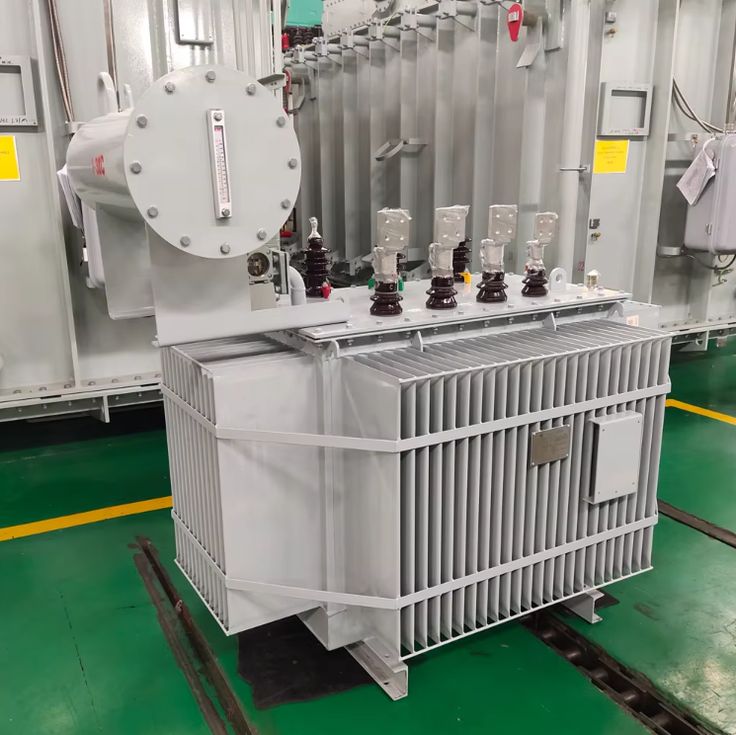
Oil immersed transformer installed in electrical substation
Infrastructure Projects
Installed in:
- Airports
- Railways
- Ports
- Data centers
Commercial Developments
Provide reliable power distribution for large commercial complexes.
Oil Immersed Transformer vs Dry Type Transformer
| Feature | Oil Immersed Transformer | Dry Type Transformer |
|---|---|---|
| Cooling Medium | Insulating Oil | Air |
| Power Capacity | Higher | Moderate |
| Outdoor Installation | Excellent | Limited |
| Fire Risk | Higher | Lower |
| Initial Cost | Lower | Higher |
| Maintenance | Moderate | Low |
| Efficiency | High | High |
| Thermal Performance | Excellent | Good |
Both technologies have important advantages, but an oil immersed transformer remains the preferred choice for high-capacity outdoor applications.
Important Selection Factors
When selecting an oil immersed transformer, engineers should evaluate several critical parameters.
Rated Voltage
Must match system requirements.
Power Rating
Determine required kVA or MVA capacity.
Cooling Method
Options include:
- ONAN (Oil Natural Air Natural)
- ONAF (Oil Natural Air Forced)
- OFAF (Oil Forced Air Forced)
Installation Environment
Consider:
- Ambient temperature
- Humidity
- Altitude
- Pollution level
Efficiency Requirements
Higher efficiency reduces long-term operating costs.
Maintenance of Oil Immersed Transformer
Regular maintenance is essential for maximizing transformer lifespan.
Recommended activities include:
Oil Testing
Analyze:
- Dielectric strength
- Moisture content
- Dissolved gases
Visual Inspection
Check for:
- Oil leaks
- Corrosion
- Physical damage
Thermal Monitoring
Monitor operating temperatures to prevent overheating.
Bushing Inspection
Ensure insulation integrity and proper connections.
Protection Device Testing
Verify correct operation of protective relays and alarms.
Proper maintenance significantly improves transformer reliability and safety.
Environmental Considerations
Modern oil immersed transformer manufacturers are improving environmental performance through:
- Biodegradable insulating oils
- Improved sealing technologies
- Enhanced leak prevention systems
- Energy-efficient core materials
These developments help reduce environmental impact while maintaining excellent performance.
Future Trends in Oil Immersed Transformer Technology
Several innovations are shaping the future of the oil immersed transformer industry.
Smart Monitoring Systems
Real-time diagnostics improve maintenance planning.
Digital Substations
Integration with intelligent grid infrastructure.
Eco-Friendly Insulating Fluids
Growing adoption of natural ester and biodegradable oils.
Higher Efficiency Designs
Advanced core materials reduce energy losses.
Predictive Maintenance Technologies
AI-driven monitoring improves asset management and reliability.

Oil immersed transformer installed in electrical substation
Frequently Asked Questions (FAQs)
What is an oil immersed transformer?
An oil immersed transformer is a transformer that uses insulating oil for cooling and electrical insulation.
Why is transformer oil important?
Transformer oil provides dielectric insulation and helps dissipate heat generated during operation.
Where is an oil immersed transformer used?
It is commonly used in substations, industrial facilities, power plants, and utility distribution networks.
How long does an oil immersed transformer last?
With proper maintenance, it can operate reliably for 25–40 years or more.
What are the advantages of an oil immersed transformer?
Key benefits include high efficiency, superior cooling, large power capacity, and long service life.
Is an oil immersed transformer suitable for outdoor installation?
Yes. It is one of the most common transformer types used in outdoor environments.
Conclusion
An oil immersed transformer remains one of the most reliable and widely used solutions for electrical power transmission and distribution. Its excellent thermal performance, strong insulation properties, high power-handling capability, and proven long-term reliability make it indispensable in utility, industrial, and infrastructure applications.
As global energy demand continues to rise and electrical networks become more advanced, the oil immersed transformer will continue to play a vital role in delivering safe, efficient, and dependable power around the world.

Wind Substation Equipment: Types, Functions, and Selection Guide
Wind substation equipment plays a critical role in collecting, transforming, protecting, and transmitting electricity generated by wind turbines. From medium-voltage (MV) switchgear and power transformers to high-voltage (HV) equipment, protection [...]

Solar Farm Switchgear: Selection, Design, and Application Guide
Solar farm switchgear is an essential part of the electrical infrastructure used to collect, control, protect, and distribute power generated by photovoltaic (PV) systems. From inverter output circuits and transformer [...]

Future-Proof Switchgear: Design, Selection, and Long-Term Reliability
Future-proof switchgear is designed and selected to accommodate changing electrical loads, evolving technologies, operational requirements, and future expansion with minimal disruption. For industrial facilities, commercial buildings, utilities, renewable energy projects, [...]