

24kV Vacuum Circuit Breaker
The following is the table of contents for this article.
Thanks for sharing the article.
Outline Table – 24kV Vacuum Circuit Breaker
| Section | Content |
|---|---|
| Introduction to 24kV VCB | Definition, MV application |
| Why 24kV Is a Critical Voltage Level | Grid standards, global norms |
| Core Components of a 24kV Vacuum Circuit Breaker | Interrupter, mechanism |
| Vacuum Interrupter Technology | Arc physics, contact design |
| Operating Mechanism | Spring, magnetic, motor-charged |
| Embedded Pole Construction | Resin insulation, benefits |
| Dielectric Performance | Internal & external insulation |
| Switching Capabilities | Load, short-circuit faults |
| 24kV VCB Ratings | Voltage, current, fault level |
| Mechanical Endurance | M2 class details |
| Electrical Endurance | E2 class switching |
| Protection Coordination | Relays, CTs, trip curves |
| Interface with Switchgear | Withdrawable, fixed type |
| 24kV GIS vs AIS VCB | Differences and selection |
| Arc Quenching Advantages | Vacuum vs SF6 |
| Safety Features | Interlocks, grounding switches |
| Environmental Advantages | SF6-free benefits |
| Standards and Compliance | IEC 62271-100 |
| Applications in Industry | Manufacturing, mining |
| Applications in Utilities | Substations, feeders |
| Renewable Integration | Solar, wind farms |
| Maintenance Requirements | Predictive maintenance |
| Testing Procedures | FAT, SAT, HV tests |
| Operational Challenges | High humidity, pollution |
| Installation Guidelines | Cabling, busbars |
| Life Expectancy & Reliability | 30+ years service |
| Future Trends in 24kV VCB | Digital monitoring, sensors |
| Common Misconceptions | Vacuum, dielectric limits |
| Buying Guide | What to check before purchasing |
24kV Vacuum Circuit Breaker Overview
A 24kV vacuum circuit breaker (VCB) is a medium-voltage switching device designed to interrupt load and fault currents using vacuum arc-quenching technology. Operating within the 12–24kV range, the 24kV class is widely adopted in global power systems due to its compatibility with medium-voltage distribution networks, industrial substations, and renewable energy facilities. The equipment provides reliable interruption, long mechanical life, and safe switching operations without the environmental concerns associated with SF6 gas.
Because the vacuum chamber maintains a nearly perfect dielectric environment, the VCB can extinguish arcs quickly, even during high short-circuit events. This makes the 24kV vacuum circuit breaker a preferred selection in modern MV switchgear systems. Its ability to provide high reliability while remaining environmentally friendly supports growing global demands for sustainable power distribution.
Why 24kV Is a Critical MV Voltage Level
The 24kV class is widely used in medium-voltage (MV) distribution networks because it fits international standards. Countries in Europe, Asia, the Middle East, and Africa commonly use 20–24kV feeders. This voltage level supports:
Urban distribution networks
Industrial feeder systems
Renewable energy integration
Utility substations
Commercial building MV panels
Because of evolving power demand, the 24kV rating became a global benchmark for medium-voltage infrastructure.
Core Components of a 24kV Vacuum Circuit Breaker
A typical 24kV VCB includes:
Vacuum interrupter (VI)
Operating mechanism (spring or magnetic)
Embedded poles
Insulated frame and supports
Control wiring and secondary circuits
Arc shields and contact assemblies
Interlocking systems
Each part influences its performance, endurance, and reliability.
Vacuum Interrupter Technology
The vacuum interrupter is the heart of the VCB. Inside the sealed chamber:
Arc forms when contacts separate
Vaporized metal distributes uniformly
Arc extinguishes as current crosses zero
Dielectric strength recovers rapidly
Because vacuum has nearly zero gas molecules, arc energy is low, resulting in:
Less contact wear
Higher endurance
Minimal heat generation
Clean operation with no pollution
24kV VCBs typically use CuCr (copper-chromium) contacts due to excellent arc resistance.
Operating Mechanism
The operating mechanism ensures fast and reliable switching.
Common types:
Spring operating mechanism – reliable, widely used
Permanent magnetic mechanism – silent and low maintenance
Motor-charged mechanism – stable energy storage
The mechanism directly affects:
Breaker speed
Contact force
Synchronization
Reclosing capability
In 24kV VCBs, high precision is essential to guarantee proper arc interruption.
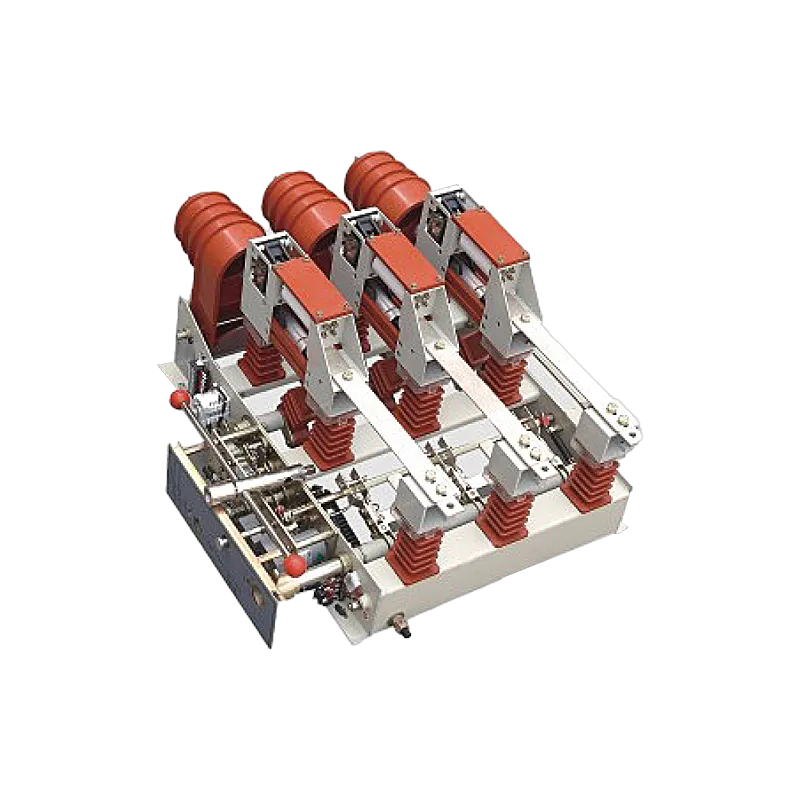
Embedded Pole Construction
Most modern 24kV VCBs use epoxy-embedded poles.
Benefits include:
Higher dielectric strength
Moisture resistance
Mechanical stability
Compact structure
Pollution resistance
This design improves reliability in harsh conditions like humidity, dust, or chemical plants.
Dielectric Performance
Dielectric strength ensures safe operation.
24kV VCB features:
High insulation level
Strong internal dielectric recovery
Solid insulation against external pollution
Creepage distance optimized per IEC 62271 guidelines
Proper insulation prevents flashovers and breakdowns even under severe environmental conditions.
Switching Capabilities of 24kV VCB
The breaker handles:
Load current switching
Transformer magnetizing inrush
Capacitor bank switching
Short-circuit interruption
Outgoing feeder protection
The vacuum arc ensures minimal stress on the contacts, enhancing its lifespan.
Ratings of a 24kV Vacuum Circuit Breaker
Typical ratings include:
Rated voltage: 24kV
Rated current: 630A, 1250A, 1600A, 2000A
Short-circuit breaking current: 16kA, 20kA, 25kA, 31.5kA
Mechanical endurance: up to M2 class (10,000+ operations)
Electrical endurance: E2 class (high fault capability)
These values ensure compatibility with global MV networks.
Mechanical Endurance
The mechanical life of >10,000 operations makes 24kV VCBs suitable for:
Frequent switching
Utility feeder operations
Industrial processes
Renewable energy systems
The simple mechanism design reduces wear compared to SF6 breakers.
Electrical Endurance
A 24kV VCB classified as E2 performs:
Multiple short-circuit interruptions
High-load operations
Capacitor switching
Transformer energization
Its contacts remain durable due to low arc energy in a vacuum.
Protection Coordination
VCBs coordinate with:
Microprocessor relays
CTs and PTs
Overcurrent protection
Distance protection
Earth fault relays
This ensures selective isolation of faults.
VCB Interface with Switchgear
The 24kV VCB can be:
Fixed type
Withdrawable type
Truck-mounted
Integrated in GIS, C-GIS, or AIS
Withdrawable designs allow safe racking and maintenance.
24kV GIS vs AIS VCB
| Feature | AIS VCB | GIS VCB |
|---|---|---|
| Insulation | Air | Gas (SF6 or dry air) |
| Size | Larger | Compact |
| Maintenance | Higher | Lower |
| Cost | Lower | Higher |
GIS VCBs are preferred where space is limited.
Arc Quenching Advantages
Vacuum interruption offers benefits:
No toxic gas
Extremely fast arc extinction
Low energy dissipation
Minimal contact erosion
High dielectric recovery
This makes vacuum the preferred MV technology.
Safety Features
Modern 24kV VCBs include:
Mechanical interlocks
Electrical interlocks
Anti-racking protection
Grounding switch interlock
Motorized charging safety
Position indicators
These enhance operational safety.
Environmental Benefits
24kV VCBs are SF6-free, meaning:
Zero greenhouse gas emissions
No leak monitoring needed
Compliant with EU environmental regulations
This aligns with global sustainability trends.
Standards and Compliance
24kV VCBs comply with:
IEC 62271-100
IEC 62271-200
IEEE C37 series
GB/T national standards
Compliance ensures global interoperability.
Applications in Industry
24kV VCBs are widely used for:
Factories
Cement plants
Mining
Ports
Steel plants
Chemical facilities
Their high reliability suits heavy-duty operations.
Applications for Utilities
Utility networks use 24kV VCBs in:
Primary substations
Secondary substations
Feeder lines
RMU switchgear
Ring main systems
They ensure reliable power distribution.
Renewable Energy Applications
Used for:
Solar farms
Wind farms
Microgrids
Battery energy storage
Their fast switching protects sensitive equipment.
Maintenance Requirements
Although low-maintenance, routine checks include:
Mechanical lubrication
Insulation inspection
VI integrity checks
Contact travel measurement
Secondary wiring checks
Predictive monitoring extends lifespan.
Testing Procedures
Factory and site tests include:
Dielectric withstand test
Contact resistance
Mechanical operations
Partial discharge
Relay function test
Testing ensures safe commissioning.
Operational Challenges
Potential issues include:
High pollution levels
Humidity
Salt spray environments
Harmonics
Overvoltage conditions
Embedded poles help overcome environmental challenges.
Installation Guidelines
Key considerations:
Proper busbar alignment
Grounding
Cable termination
Safe racking procedures
Relay calibration
Correct installation ensures long-term reliability.
Life Expectancy & Reliability
A 24kV VCB typically lasts:
25–35 years, depending on usage
Even longer with proper maintenance
Vacuum technology inherently offers high reliability.
Future Trends
Smart VCBs with sensors
Digital monitoring
IoT predictive maintenance
SF6-free compact GIS
Magnetic actuator mechanisms
The future is moving toward fully digital MV switchgear.
Conclusion
The 24kV vacuum circuit breaker is a critical technology in modern medium-voltage power distribution. It provides reliable interruption, long service life, environmental benefits, and strong dielectric performance. Whether used in utilities, industrial plants, or renewable energy systems, the 24kV VCB remains an essential component of safe and efficient electrical infrastructure.

Wind Substation Equipment: Types, Functions, and Selection Guide
Wind substation equipment plays a critical role in collecting, transforming, protecting, and transmitting electricity generated by wind turbines. From medium-voltage (MV) switchgear and power transformers to high-voltage (HV) equipment, protection [...]

Solar Farm Switchgear: Selection, Design, and Application Guide
Solar farm switchgear is an essential part of the electrical infrastructure used to collect, control, protect, and distribute power generated by photovoltaic (PV) systems. From inverter output circuits and transformer [...]

Future-Proof Switchgear: Design, Selection, and Long-Term Reliability
Future-proof switchgear is designed and selected to accommodate changing electrical loads, evolving technologies, operational requirements, and future expansion with minimal disruption. For industrial facilities, commercial buildings, utilities, renewable energy projects, [...]